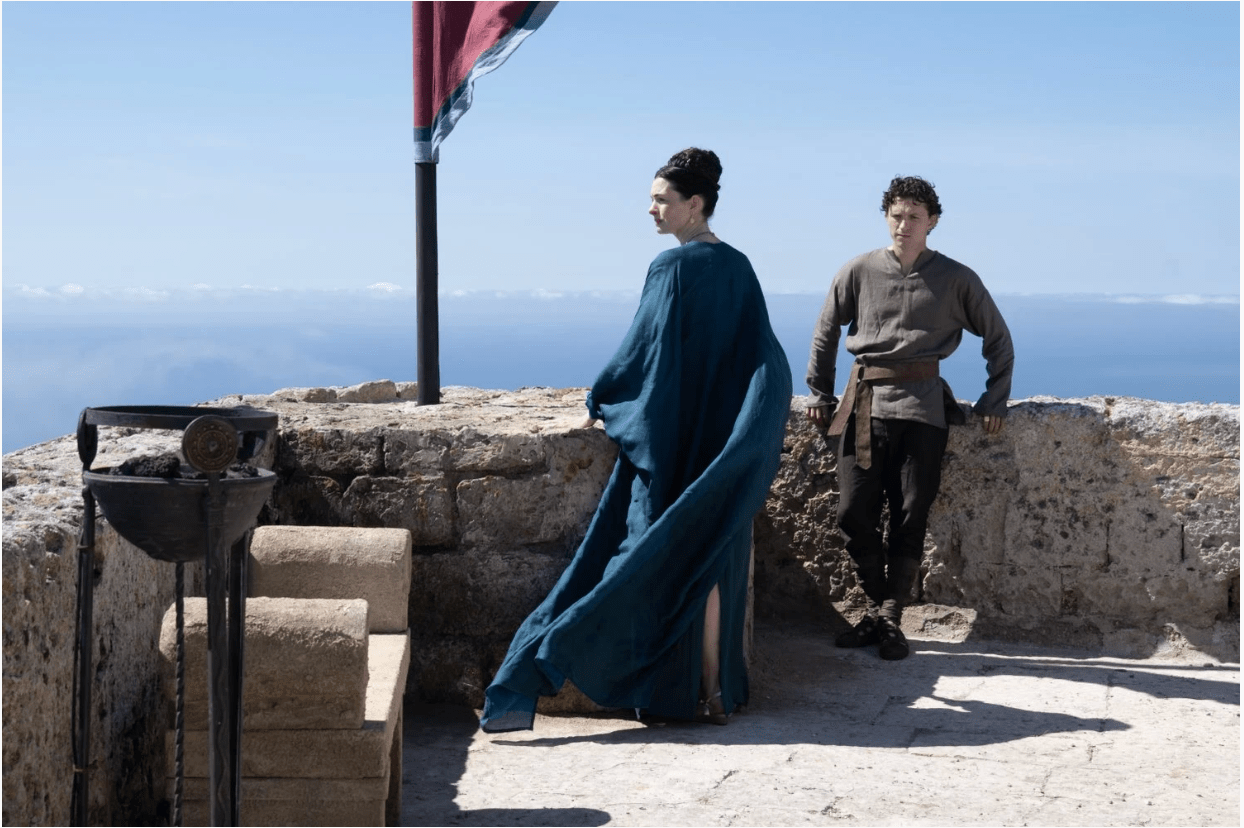
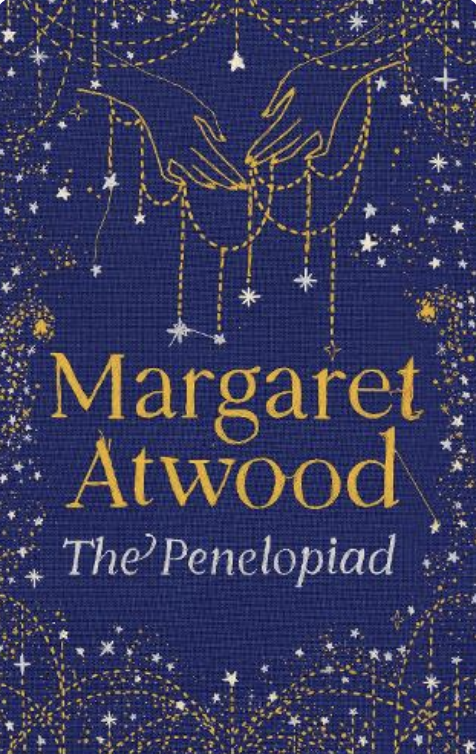
Canadian writer Margaret Atwood (The Penelopiad, 2005) and actress Anne Hathaway (seen above with Tom Holland as Telemachus in the 2026 Christopher Nolan film The Odyssey [credit: Universal Studios]) have both portrayed Penelope — hero Odysseus’ long-suffering wife — as a feminist icon and heroine in her own right. Indeed, while her husband’s fraught 20-year journey back from Troy to Ithaca is the objective subject of Homer’s classic 6th–8th century BC epic (Note: the exact date of the written version is uncertain, being that it was initially told via oral tradition), Penelope’s inner journey (from assailed wife to victorious queen) is worthy of its own bardic retelling — not to mention a source of multiple meaningful metaphors for our times… as well as for me, personally. As many things I/we are facing concur with this timely cinematic offering, I felt inspired to write my own reflections as below on the film/story as it relates to these.
For those who haven’t read Homer’s epic poem or seen the film yet, here’s a brief-ish recap: the hero Odysseus sets off from his kingdom in Ithaca on a mission to destroy Troy and bring back the abducted wife (Helen of Troy, whose face famously “launched 1,000 ships”) of King Menelaus of Sparta, leaving his own wife Penelope and young son, Telemachus, to manage alone at home. Although the Greeks, led by Agamemnon, were ultimately victorious, the 10-year siege of Troy was only resolved when Odysseus (inspired by Athena, goddess of wisdom) suggests the Greek warriors enter the heavily fortified city hidden inside a huge wooden horse masquerading as an offering to Athena.
However, instead of making a direct beeline back home to his wife and son (and kingdom) in Ithaca, Odysseus ends up taking the scenic ‘odyssey’ route instead (as the joke goes, “he was odd, you see”). He and his men wander around the seas for a further 10 years, encountering gods, goddesses, monsters and sorcery (eg, a witch named Circe who turns his men into pigs, and a nymph named Calypso who keeps him stoned and bewitched on her island for seven years by feeding him psychedelic lotuses [Note: in the poem, the lotus-eaters are a tribe on a different island who live on a honey-sweet plant that cause them to forget their homes] ). Although his men keep dying horribly gory deaths, Odysseus is seemingly having a Charybdis whale of a time, despite constant trouble sent by the offended Poseidon, god of the seas.
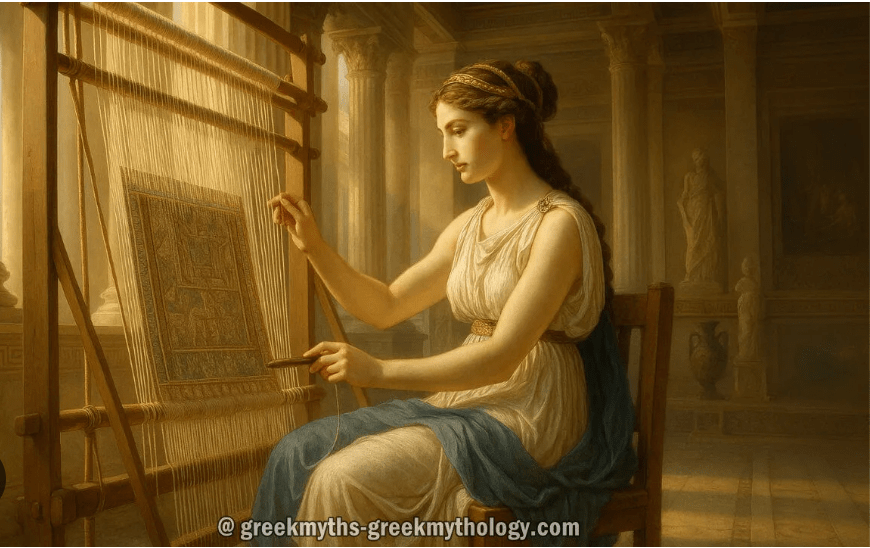
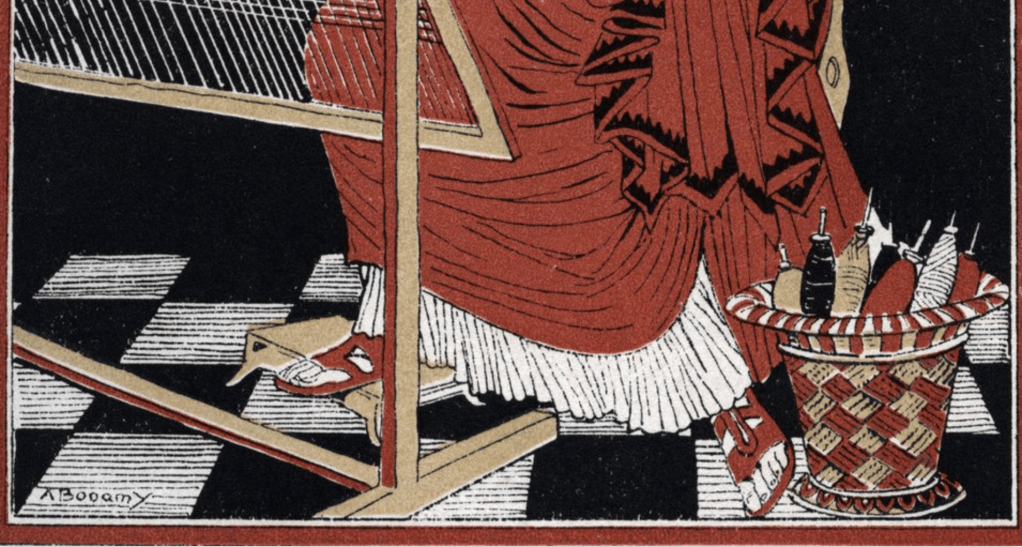
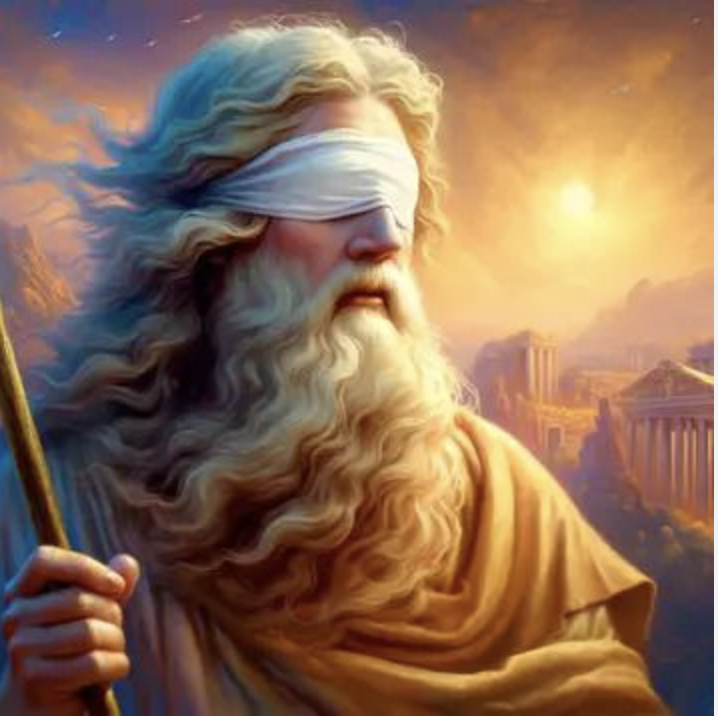
Meanwhile, Penelope — commended for her wisdom, virtue and fidelity — not only has to raise their son Telemachus alone and manage the affairs of the kingdom with the help of her maidservants and the blind, loyal seer Tiresias throughout her husband’s 20-year absence, but also find a clever way to put off the 108 boorish suitors who besiege her daily with impatient requests for her hand. These entirely unworthy and uncouth types take up residence in their palace (hospitality being regarded as a sacred duty), literally eating her out of house and home while demanding she choose one of them as Odysseus’ replacement. Penelope tells them they must wait until she has finished her father-in-law Laertes’ death shroud, which she weaves by day and unpicks by night.
As the suitors become increasingly impatient, scheming and getting up to all kinds of nastiness, Penelope finally tells them she will give the throne to the one who can string and fire arrows through Odysseus’ bow as effectively as her husband did. This fateful competition takes place just as Odysseus finally returns to Ithaca. Warned by Athena and others about the antagonism of the suitors and their belief he is dead, he turns up dressed as a blind beggar, recognised only by his faithful hunting dog Argos and a servant. He then proves himself as the long-lost king by picking up, easily stringing and firing his uniquely shaped bow. Then he slaughters the lot of them, before finally he and Penelope are reunited, then (in the film version; see below for the poem ending) sailing off into self-imposed exile while leaving their now-grown son Telemachus to take over the leadership of Ithaca.
Penelope as a female (feminist) ‘heroic’ archetype
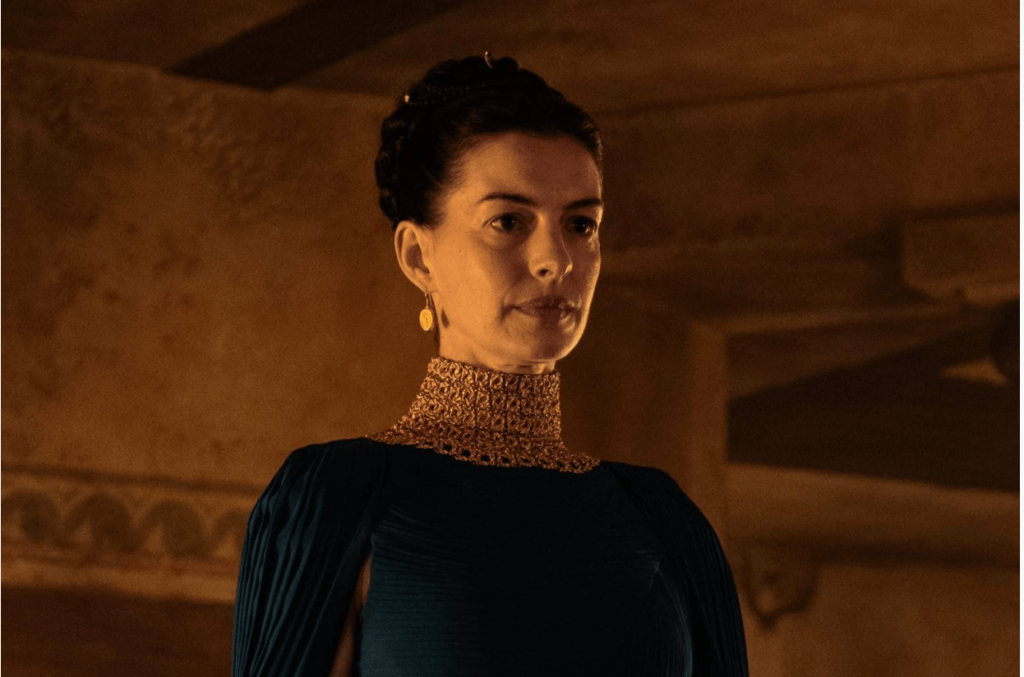
In Nolan’s filmic retelling of the myth, Anne Hathaway’s raw but powerful performance of Penelope gives credence to the Homeric character’s viability as a feminist icon and heroine. Hathaway’s Penelope is a woman and mother who, while equally as flawed and perhaps as troubled and complex as her husband, nevertheless remains stoically committed to her own core beliefs and values. Her unflinching courage, persistence and craftiness — despite wrestling her own inner doubts as well as the siege of suitors who assault her peace with their demands and schemes — enable her to hold fast, thus earning her her own place among the mythological immortals for her legendary fidelity.
Although in the film we see flashbacks of her enjoying marital relations with her husband prior to his departure, the two characters are depicted as equals in bed, if not perhaps in sexual fidelity. (Note: Although various accounts claim Penelope had relations with Antinous and all 108 suitors at the palace who attempted to take Odysseus’s place in her bed, Homer’s version never makes such assertions.) While Hathaway’s Penelope shows a mix of strength, beauty, earthy desire yet vulnerable femininity that could make her seem capable of being unfaithful, she clearly steels herself and refuses to waver, committed as ever to her love for her husband.
Penelope’s inner journey — from abandoned, grieving/questioning wife to authoritative, wise and ultimately justified queen — is a metaphor for women’s internal ‘odyssey’: from maiden > wife/mother > grieving widow > wise woman > powerful queen/ruler > goddess/demigoddess
Thus, while Odysseus’s wanderings and triumphant, revelatory return serves as an archetype or template of the classic hero’s journey, Penelope’s inner journey — from abandoned, grieving/questioning wife to authoritative, wise and ultimately justified queen — is a metaphor for women’s internal ‘odyssey’: from maiden > wife/mother > grieving widow > wise woman > powerful queen/ruler > goddess/demigoddess. Her final test for the suitors — the occasion in which her returned husband reveals himself — shows not only her sharp calculations of the best way to finally defeat the suitors, but also her core belief that no one will be able to match her husband’s sagacity and skill, and thus be worthy of her hand in marriage.
This scene encapsulates what many of us women recognise to be true: becoming queens and rulers and life means learning to: a. subject our own emotions and weakness to a higher calling; and b. fully engage our brains, feminine wiles and skills to outwit men and thus achieve our own own full authentication. Thus, Penelope easily resonates with us as a feminist role model for our times, matching her husband as equally heroic. She demonstrates what she knows to be true: she is a worthy partner to Odysseus in wisdom, cleverness and skill; she, too, has conquered her inner monsters and triumphed, achieving her own vindication and right to be included in the Greek pantheon of demigods and heroes. Together, guided by the goddess of wisdom, Athena, the two of them prove they (and their son) are the only mortals fit to rule Ithaca.
Whether Homer actually intended to make Penelope’s character’s trajectory as equally heroic and morally didactic as her husband’s, we can certainly take it as such. For though the Roman world was all about the patriarchy, the Greeks — specifically in terms of gods and myths — were far better at giving women an equal share in the pantheon.
My personal Penelopiad
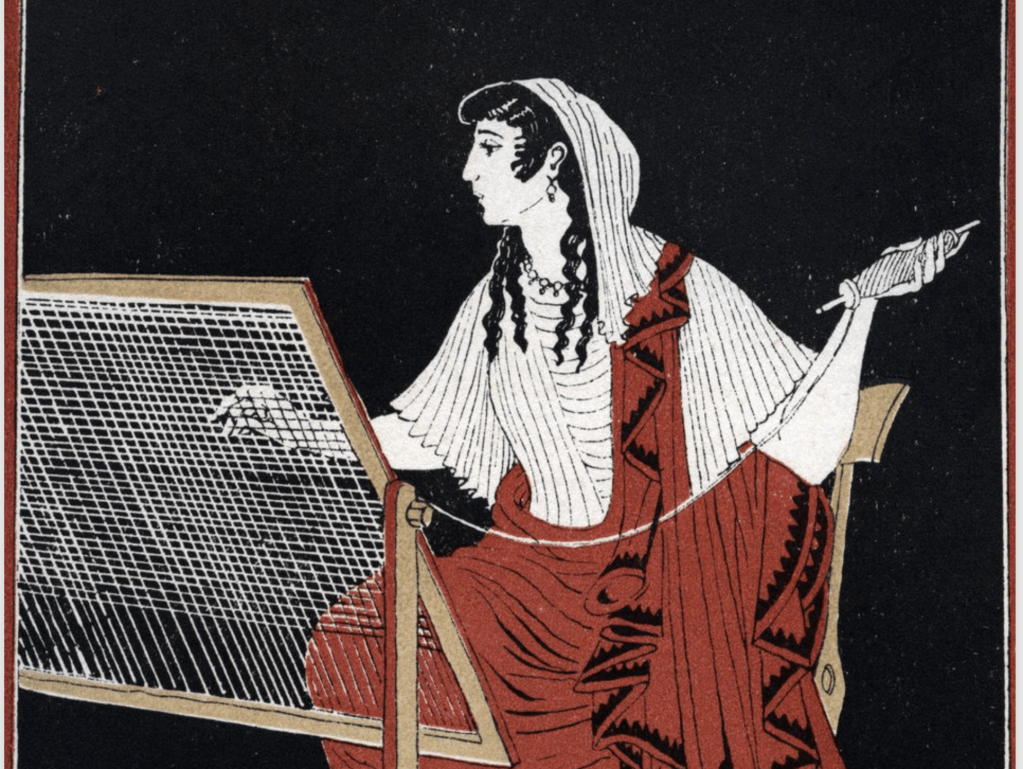
Even before the film was released, Penelope’s story has often occurred to me as a vitally pertinent metaphor for my own life — not least because I seem to have been both endlessly writing and re-writing / revising my historical fiction trilogy, eg my own writerly version of weaving, unravelling, and re-weaving while simultaneously navigating the often-unruly sea-changes of life as a widow. (Ironically, although the working title for the series is The Netsuke, I have often considered titling the first book in the series Joost’s Journey or An Artist’s East Asian Odyssey.) Also, like Penelope, I have had to become resilient in the face of tragedy; embrace a stubborn persistence by not giving up on life, nor my personal dreams of success and quest for meaningfulness in spite of my losses; and having to ‘re-authenticate’ or relearn my identity as a now-solo woman.
Since my husband’s sudden illness and death two years ago (as I wrote about here) and subsequent experiments with online dating (as here), I have battled plenty of inner monsters as well as a slew of ‘unworthy suitors’ grappling for my attention, most of whom I have at least mentally put off by telling myself I won’t truly be ready or available until my novel trilogy is finished, polished and published. I am also painfully aware I have not yet managed to de-clutter my house with all its 28 years’ accumulated memories of our life together, an integral part of my actual coming to terms with and letting go of my loss. I do realise this procrastination is perhaps symbolic of an unconscious ‘hope against hope’ my husband might actually return, as Odysseus did, from the land of the (suspected) dead.
However, unlike Penelope’s virtuous role model, I have perhaps at times allowed my flawed, human need for companionship to expose me to kissing quite a few frogs (eg, unworthy suitors). My latest effort to trial dating again has been via Facebook Dating, which, unlike most of the dating apps I previously tried, is free; although it has its own occasional tech issues, it has at least offered a few genuine human encounters, including a few decent local-ish blokes I have actually met and/or dated in person (one of whom I am now seeing regularly; though it is still early days, it does seem promising, at least for now). But Facebook Dating has plenty of the other type of usual online-dating suspects (not catfishers, as per the paid-for apps, but men looking for you-know-what-only). (This also includes plenty of younger men eager to ‘date’ an older woman [possibly as a maternal stand-in, who knows], as well as digital-first–era daters who consider a daily bombarding of emojis equivalent to conversation, lol.)
They say part of grieving is not only the loss of that person, but also the person you were with them
However, like Penelope, my experiences of other ‘suitors’ — including the good, the bad and the downright ugly — have generally increased my conviction that no one will ever match my husband in having the same qualities, nor will I ever have the same kind of relationship as I did with Roland. After 28 years together, it is hard to imagine anyone will ever know, understand or cherish me as he did!
They say part of grieving is not only the loss of that person, but also the person you were with them. I’ve slowly come to accept that while I might meet someone with whom I could learn to love and live again, it will certainly not be the same relationship I had with my husband Roland. Indeed, apart from him, only God knows and loves me that intimately as my true ‘husband’ and the lover of my soul — so, metaphorically, at least as of the present time, He is still the only being who can, as it were, string my awkward bow and hit every bulls-eye target straight to my heart.
But indeed, life — both our inner and outer journeys — does go on. As per Penelope’s trajectory (from embattled and supposed widow to confident queen and ruler of her own life), I must fight my own inner demons of grief, sorrow, despair, meaninglessness and just plain tired-of-it-all-ness, developing a quiet inner strength in their place. Like my novel(s), it’s been an ongoing work-in-progress, developing fortitude (perseverance), resilience in tackling the various challenges of ruling my ‘kingdom’ (eg health, household and finances) on my own, as well as reclaiming my individual self as no longer a ‘we’ but an ‘I’. Yet, as with all writerly works-in-progress, you have to keep working through various drafts until you finally reach a place where it is at least mostly ‘done’. (Btw, I am still working to my target of getting the final book of the trilogy query-ready by summer’s end; not sure if I’ll make that, but I do hope to get it out there by next year at least!)
A parable for our times, too?
Another key theme or metaphor, both in the film and Homer’s poem, is the way Odysseus’s circular, PTSD-driven wanderings, the doom of almost all his men post-Troy and the apocalyptic images of the burning city illustrate the collapse of Bronze Age Mycenaean civilisation (see this scholarly article on Medium, “Homer as the Last Witness of a Lost Aegean World” ). Indeed, The Odyssey paints a retrospective portrait of an era characterised by fractured political authority; abandoned palaces testifying to once-powerful kingdoms destroyed by war, strife, internal corruption, famine and other disasters; and lost international trade, ending former mighty sea-trading empires.
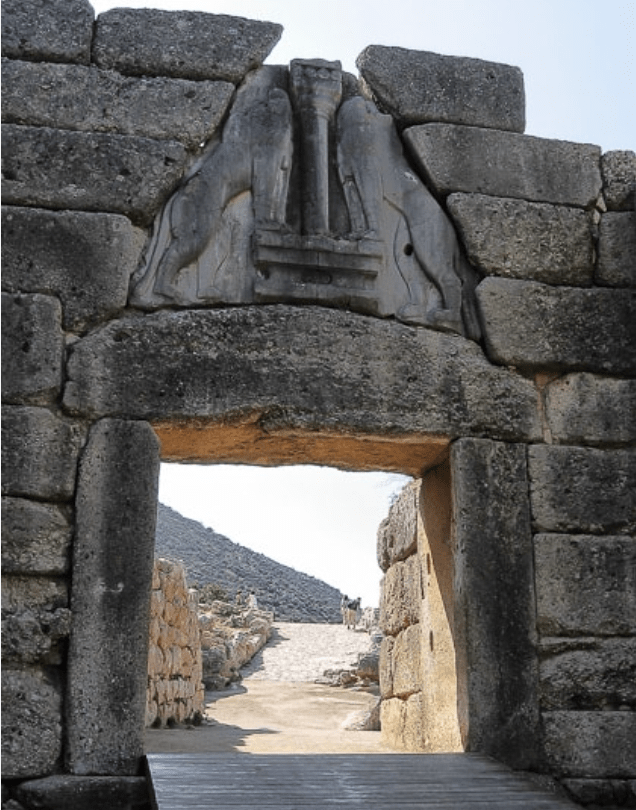
This is particularly relevant for our present time as we are clearly hurtling towards a major societal turning (or breaking) point. Not only are there looming threats of a third world war amid the destabilising of former peaceful allied political networks (NATO) and various fascist rumblings in the US, UK and elsewhere, but the rapid advances in artificial intelligence (AI) threaten to drive the end of human civilisation as we know it. This is not just about man-made (and billionaire-controlled) machines replacing human jobs, but the fact their reliance on resource-intensive data centres (and tonnes of water) will accelerate the already profound climate-change impacts now happening with alarming frequency and severity, as below.
Also, the US — once the self-appointed ‘leader of the free world’ — is now run by a corrupt, despotic and increasingly demented buffoon who has already launched an aggressive attack on Iran, causing a massive blockage of international trade ships in the Strait of Hormuz. In another striking parallel with Homer’s epic, just as the Greeks finally broke through the seemingly impenetrable walls of Troy by masquerading as an offering to Athena, so too the current administration has stolen into the Oval Office by pretending to represent ‘Christian’ values (including the sacred cow of American patriotism, or ‘flagolatry’, as I call it), effectively turning what was once a Christian nation into a replica of Hitler’s Nazi Germany. No sooner had Trump’s Republican cronies entered the White House than they began scaling the once-unassailable Constitution, destroying the guardrails put in place long ago to protect the US democracy from being taken over by fascists, despots and oligarchs — the very scenario presently transpiring before our eyes.
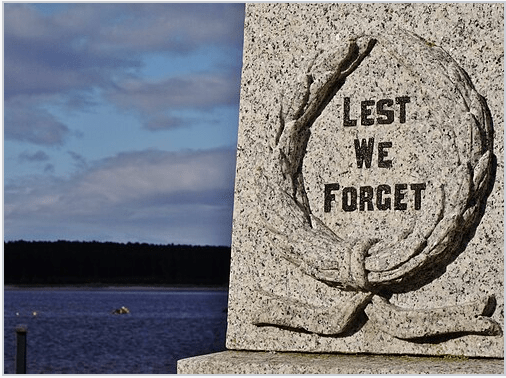
How could we not see this coming? What part of ‘never again’ or ‘lest we forget’ did we erase from our collective memory?
Ironically, while Odysseus and Penelope appealed to the goddess of wisdom, the tangerine temper tantrum does nothing but glory in being ‘dumb and dumberer’, appealing to the mass of media-zombified citizens who no longer seek objective wisdom or know how to think critically for themselves, and thus applaud his dementia-addled ramblings on his ‘Truth Social’ platform as ‘truth’. Surely, the massively embarrassing gaffes and spectacles Dumbph (my term for the ‘Prez’) made of himself recently — bizarrely referring to Iran as ‘the Islamic Republic of Japan’ in a NATO meeting in early July and refusing to leave the FIFA World Cup stage at the end of the tournament, among others — signify America’s complete and utter breakdown in no uncertain terms.
How could we not see this coming? What part of ‘never again’ or ‘lest we forget’ did we erase from our collective memory? Perhaps we have indulged far too long in our own brand of lotus-eating — mass consumerism, addictions to media (social media and seductive substances such as sex, drugs, rock’n’roll, image, celebrities, etc) to have retained any ability to recall those horrors that only less than a century ago plunged the world into a scary, near-Apocalyptic end. Alas, it seems inevitable that “The only thing we learn from history is that we fail to learn from history” (a shortened version of German philosopher Georg Wilhelm Freidrich Hegel’s remarks in his work The Philosophy of History).
Invoking the wrath of God (the gods)
So far, along with the UK release of director Chris Nolan’s film The Odyssey on 17 July, this summer has indeed been epic, in that it has been filled with devastations of epic proportion — most notably, a rash of climate change-related global catastrophes (ironically, this word derives from the Greek katastrophē, meaning ‘to overturn’, ‘a reversal of what is expected’ or ‘a sudden end’). These include:
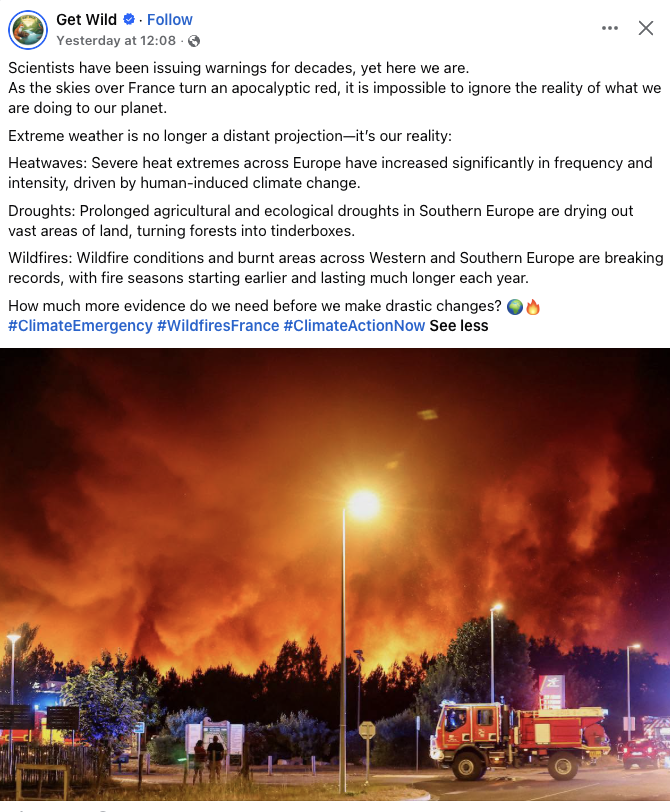

- Intense, record-beating heatwaves in May, June and July, killing over 2,700 in the UK (according to a Met Office report) and an estimated 10,000 in Europe (Euronews).
- Severe wildfires in Ontario, Canada, Texas in the US, Spain, France, Sicily, Norway, Scotland, Bolivia, Algeria, England, Wales and Tunisia are forcing thousands of evacuations, filling skies with ominous clouds of toxic yellow and orange smoke/smog.
- Several high-magnitude earthquakes (the most recent in offshore Chiapas, Mexico), three in Mindanao, The Philippines, two in Venezuela, and one each in offshore Honshu, Japan, offshore Kamchatka, the South Atlantic Ocean (mid-Atlantic ridge), Qinghai, China and Sulawesi, Indonesia.
- Devastating famine and drought in Sudan, South Sudan, Somalia and Gaza.
- Lastly, several incidences of intense flash flooding, as seen in the Gulf of Guinea, West Africa (Côte d’Ivoire, Ghana, Togo, and Nigeria), China, Georgia, Syria, France and the US (specifically, Texas and Utah).
If the ancient Greeks of Homer’s time were witnessing these ‘divine portents’ or ‘omens’ of nature’s fury happening simultaneously around the globe, they would undoubtedly conclude the gods were wreaking vengeance on man for his foolish, greedy and destructive ways. How then can we, with all our supposedly ‘advanced’ knowledge, fail to read and respond to such blatant messaging and ‘distress signals’ from our planet?
(Or, as a former US Chiffon margarine commercial jingle once said, “It’s not nice to fool Mother Nature!” — whether you believe in the Judeo-Christian monotheistic God, the Greek gods or the modern gods of science, it is clear Gaia/Mother Earth is gearing up for a massive upheaval, and will eventually spit her horribly and grotesquely deformed human children out so she can get on with the work of rebuilding herself anew!)
Conclusion: On Forgetting (and Waking Up)
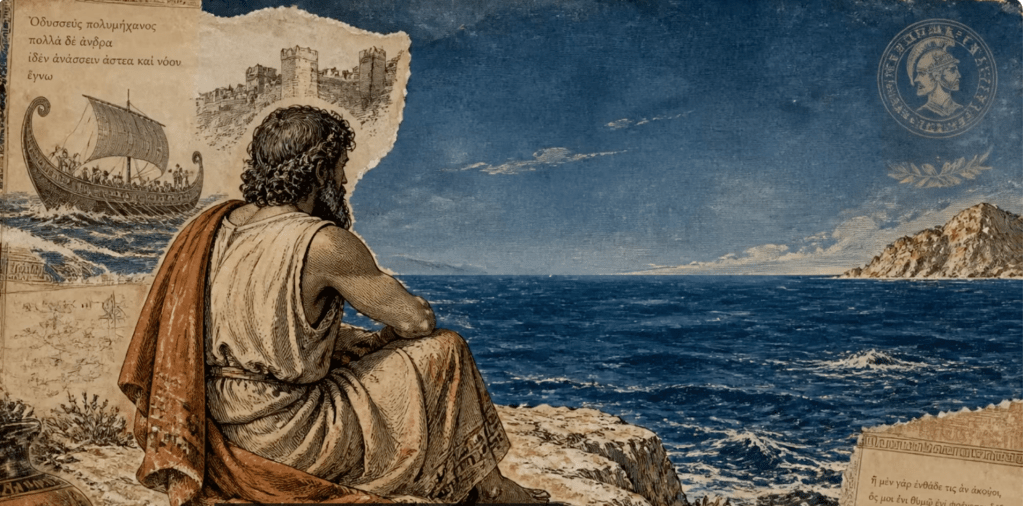
Ultimately, in the real (non-film) version of Homer’s Odyssey, after Odysseus’s suitor-slaughtering frenzy, the goddess Athena (disguised in mortal form as Mentor) appears as a ‘Deus ex machina’ to enforce a truce/peace — in part by causing a divine forgetfulness (oblivion) of all the things that triggered the wars. In this case, forgetting is a beneficial thing, akin to finding peace through forgiveness and/or ‘letting it go’.
However, there are many instances in The Odyssey where such forgetfulness is deeply problematic: for example, when Odysseus’s men forget their manners while gorging themselves on sorceress Circe’s stew, it stirs her to turn them into a herd of pigs; later, not having learned that same lesson, his men also conveniently ‘forget’ that the cattle they are ravenous to eat belong to the Sun god Helios, thus further provoking Zeus’s fury and rage. And although Odysseus’s forgetfulness during his long sojourn with Calypso is seemingly ‘blissful’ in that he does not have to contend with painful memories of who he is, where he came from and horrific scenes of savagery at Troy, it ultimately only leads him into a false or temporary peace.
Some historians have argued the real story of The Odyssey is the hero’s difficult decision: stay with Calypso, become immortal, never have to deal with pain and suffering again, or stay mortal and go back home to the wife, child and land he truly loves? Yet perhaps it is the fact he is not a god, but a mortal, that eventually, Odysseus wakes up, smells the stinking coffee brewing back home and finally lets go of his own hang-ups about his own failures and human fallibilities long enough to remember his responsibility to his wife, his son and his kingdom. It might have taken him 20 long years and lots of battering by various gods/demigods, seas and monsters, but once he finally gets it, he walks in and ‘saves the day’, literally just in the nick of time.
So, what does this mean for us today? Faced with the present ‘bleak and bleakerer’ scenario, many people today are responding to gloomy, disaster-heavy headlines with the belief if they simply ignore the bad news everywhere, it will go away of its own accord, leaving them to pursue their own inner peace for whatever remains of their (our) earthly existence.
Yet while such forgetfulness may sound like solid mental health and well-being guidance, the unfortunate truth is we do not live in a bubble. If it happened to them — eg the Mycenaeans of the Bronze Age, the ancient Minoans, the Egyptians, the Roman Empire, even the mythical Atlanteans — it could certainly happen to us, even in our own backyard. Therefore, seeking solace only via self-preservation is not only irresponsible towards other humans, but to the entire fabric of life on our planet (eg, Earth’s beleaguered ecosystems) that support all life — including your own.
If the ‘lest we forget’ message of the previous century — and the climate warnings of scientists since the ’70s and before — fail to herd us in the right direction, will it take a similar Deus ex machina to get us to finally “wake up, and strengthen the things that remain”?
If the ‘lest we forget’ message of the previous century — and the climate warnings of scientists since the ’70s and before — fail to herd us in the right direction, will it take a similar Deus ex machina to get us to finally “wake up, and strengthen the things that remain, that were about to die” (Revelations 2:3) before it truly is too late?
Perhaps, rather than patiently waiting and steeling herself as Penelope did, using all her mental agility to outwit her suitors, the most sobering message from Homer’s Odyssey is that, like the eponymous hero, we must urgently wake up, rid the world of its present parasitic would-be kings and restore nature / the natural order of things while we still have time — that is our only hope of achieving a true and lasting peace. For if we do not do it, the gods (God Himself) surely will!

