
Apologies to my readers as it’s been a while since I posted anything, but I have had quite a lot going on in the past few months, which I’ll explain briefly here – however as I am departing today (finally!) for a three-week trip to Japan, I promise to write a review of my trip with copious images and useful tips for anyone who wishes to go there once I return. (Apparently Japan is the top destination of 2024, though it’s actually been on the cards for me to go there for some time – not only as a bucket-list destination but because I’ve been researching and writing about Japan for some time now, so I really need to see and experience it for myself!). I will arrive in time for the famous sakura (cherry blossom) season – hopefully it will look as dreamy as in the pic used here!
Since the purpose of this trip is primarily for novel research (for those of you who don’t know or haven’t read my other blog posts mentioning this, I’ve spent the past 3+ years researching and writing a historical fiction novel – my first – set in early Edo-era Japan [roughly 30–35 years after the events chronicled in James Clavell’s epic novel Shogun – now the subject of an exciting new updated series available on Disney+]), I will be going to a few remote or off-the-beaten places as well as the classic ‘Golden Triangle’ (Tokyo–Kyoto–Osaka) favourite tourist spots.
While I had originally planned to travel on a ‘Shogun Trail’ tour with a group via operator Explore! and then go off to do my own travel exploration and research, this didn’t pan out as expected (all God’s perfect plans, I’m sure), so now I will be travelling solo for the entire trip, with a ‘self-guided itinerary’ provided by Australian company Gluten Free Tours Japan, which specialises in supplying bespoke tours including specially catered foodie treats for those with coeliac disease or who are highly gluten-intolerant as I am. It’s clearly a niche business, since gluten-free food is very hard to find in Japan – apparently coeliac disease is unheard of there.
My present 18-day itinerary looks like this: I will arrive in Tokyo after nearly 19 hours in a plane going via Hong Kong, stay for 5 nights to sightsee and meet fellow Japanese writer and dancer friends, etc, and include a day trip to UNESCO World Heritage site Nikko. I then plan to visit YWAM (Youth With A Mission) Tokyo for insight into how to pray for Japan and all that God has been doing there, as reading about and researching the dramatic persecutions of Christians (as seen in Martin Scorcese’s powerful 2016 film Silence) and the history of the church in Japan has inspired a desire to pray for a fresh move of God’s Spirit in this ‘land of the gods’ (although Buddhism is also quite popular and is also strongly rooted in Japan, most Japanese follow Shintoism – an indigenous religious belief and practice that includes ritual devotion to a multitude of kami or gods).
After this, I will head to Hakone for an overnight stay. A short trip from Tokyo, this is a beautiful mountainous area famous for its stunning views of Mt Fuji, red torii gate* proudly guarding Lake Ashinoko, volcanic hot springs (you can apparently get a black egg boiled in the volcanic crater at Owakaduni; not sure if I will have time for this though), traditional Japanese inns known as ryokans offering bathing in thermal onsens – a unique cultural must-do in Japan – and its historic association with the ancient Tōkaidō coastal footpath route that visiting daimyō (feudal lords) used in their annual pilgrimage (sankin-kotai) to pay tribute to the Shōgun at Edo (Tokyo), which I have written about and am keen to walk at least part of.


From Hakone and Odawara, I will then head on to Kyoto – the ancient imperial capital of Japan, famous for its well-preserved historical Gion district where modern-day geisha can be seen strolling the cobbled streets. It has many shrines and temples, including the famous, picturesque, gold-covered Kinkaju-ji Buddhist temple. I am particularly keen to visit the Arashiyama Bamboo Forest and relax on the charming Sagano Scenic Railway train while taking in the beautiful scenery, as well as to visit the Fushimi-Inari Taisha shrine with its long parade of brilliant vermillion torii gates, though am aware I will have to get there at the crack of dawn to beat the hordes of tourists at each of these spots, or alternatively go later in the evening. I hope too to experience a traditional tea ceremony and of course get professionally attired in a kimono, perhaps even get made up like a geisha too!
Next I will go to Osaka. As well as serving as my base for day trips to the well-preserved and visually stunning Himeji Castle and the ancient capital of Nara (known for its friendly, inquisitive deer that supposedly bow to you Japanese-style when you offer them crackers), I am looking forward to exploring this lively city’s vibrant gourmet food culture – particularly savouring gluten-free variations of popular dishes such as tempura, teppanyaki, okonomiyaki pancakes, ramen and soba noodles. I also hope to enjoy the salsa version of its equally vibrant nightlife scene by visiting the Shall We Dance Café, hopefully connecting with a few international salseros/as I know.
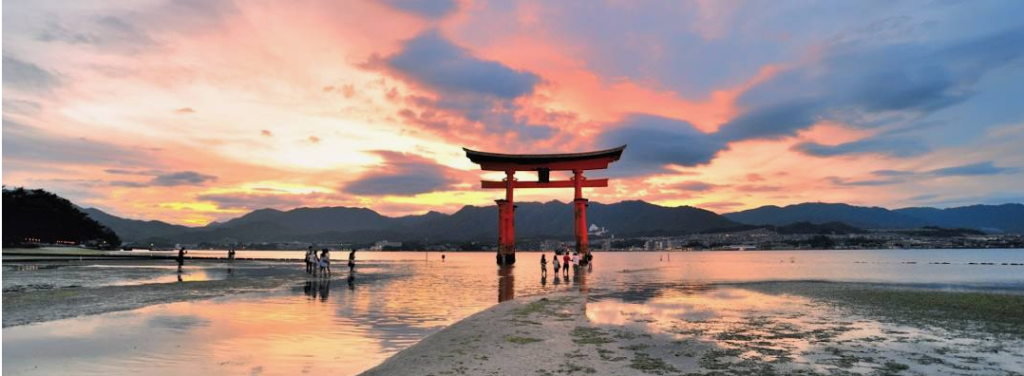
Next up is Miyajima – site of the iconic ‘floating’ torii gate set on the outskirts of Itsukushima Island – where I will be staying in a traditional ryokan that also offers a gluten-free version of a multi-course kaiseki meal. Thankfully the Japan Rail Pass I pre-purchased covers the ferry from Hiroshima to the island, which is also known for its ample deer population. I do wish I had more time to linger here, but I am excited about the overnight stay as an opportunity to see the torii at both sunset and sunrise. I also regret I won’t likely have time to visit the sites connected with the horrors of Hiroshima’s atomic past, but as that is more recent than the events in my novel, I will have to see it another time.
From there I head to Nagasaki to explore northwest Kyushu – Japan’s largest southern island. Since this is the area most connected with my novel, I felt it was important to have expert local knowledge, so have booked a highly recommended local guide named Yukihiro (Hero) of Go With Guide for four full-day research and sight-seeing trips specifically to fact-check and enhance the descriptions of events and locations featured in my novel. (Btw, I have now nearly completed the revised first draft, and next will enter the more thorough editing and revision stage of the whole manuscript – although I had hoped to complete this before I travelled, it has not been possible because of the amount of time required for planning [and then re-planning] this trip, as well as the recent unexpected death of my father in the US. However once we have lain his ashes to rest finally, and with the input from this trip, I do hope to finish it soon for my father’s sake, and will now certainly dedicate it to his memory).
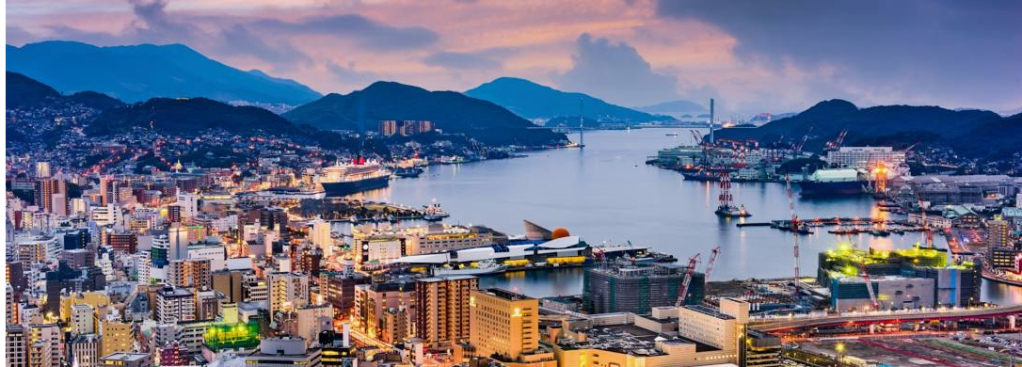
Nagasaki’s famous harbour, evening and night views 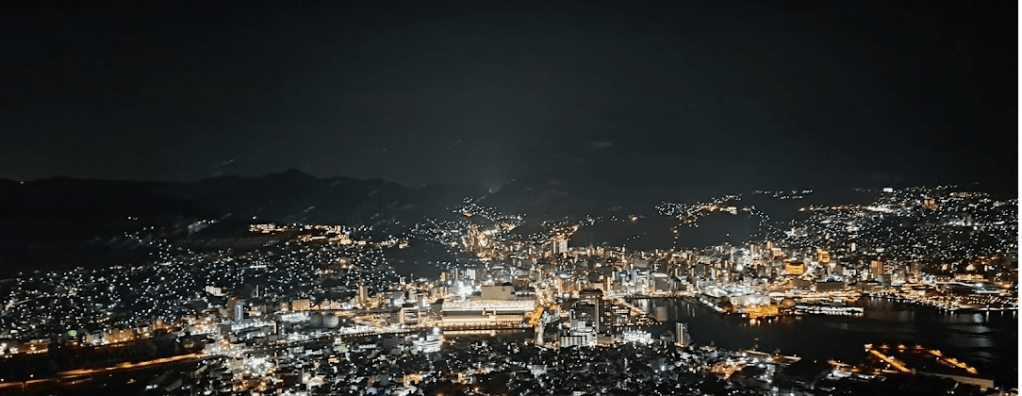
I am particularly excited that Hero will be able to drive me all around Kyushu to visit many remote sites connected with the Shimabara Rebellion and Japan’s hidden Christians, as well as sites connected with the Dutch East India Company (VOC), since these are key subjects in my novel. These include Dejima – the artificial island in Nagasaki’s harbour where first the Portuguese and then the Dutch merchants were confined to for well over 200 years; the Dutch Trading Post in Hirado; and the myriad islands off the coast of Kyushu that offered shelter and hiding places to many Chinese merchant-pirates, shipwrecked Dutch and European travellers and thousands of exiled Japanese Christians.
Lastly, along with my ‘serious’ historical research, I am also looking forward to having fun at the Nikko Edo Wonderland Park and Huis ten Bosch in Sasebo – both of them modern-day recreations of Japanese and Dutch life in the time I am writing about. They may be a little kitsch, but I can’t really leave Japan without at least touching a bit of everything kawaii (cute), can I?
Well, I have to close this now as need to finish packing and get ready for my flight. Until I return to tell you all about it, sayonara!
*According to Wikipedia, a torii (Japanese: 鳥居, [to. ɾi. i]) is a traditional Japanese gate most commonly found at the entrance of or within a Shinto shrine, where it symbolically marks the transition from the mundane to the sacred and a spot where kami are welcomed and thought to travel through.
 Small Writer at Large
2 thoughts on “Update on novel and upcoming Japan trip”